<?xml version="1.0" encoding="utf-8"?><feed xmlns="http://www.w3.org/2005/Atom" ><generator uri="https://jekyllrb.com/" version="4.4.1">Jekyll</generator><link href="https://rocketlabdelta.com/feed.xml" rel="self" type="application/atom+xml" /><link href="https://rocketlabdelta.com/" rel="alternate" type="text/html" /><updated>2026-04-16T20:05:36+00:00</updated><id>https://rocketlabdelta.com/feed.xml</id><title type="html">Rocket Lab Delta</title><subtitle>Rocketry projects and resources</subtitle><author><name>Dan Brubaker Horst</name></author><entry><title type="html">2020 Year in Review</title><link href="https://rocketlabdelta.com/updates/2020-year-in-review/" rel="alternate" type="text/html" title="2020 Year in Review" /><published>2021-01-01T23:30:30+00:00</published><updated>2021-01-01T23:30:30+00:00</updated><id>https://rocketlabdelta.com/updates/2020-year-in-review</id><content type="html" xml:base="https://rocketlabdelta.com/updates/2020-year-in-review/"><![CDATA[<h2 id="by-the-numbers">By the Numbers</h2>

<p>Launches attended: 1<br />
Rocket flights: 0<br />
Total Ns: 0</p>

<p>Kits purchased: 4<br />
Kits completed: 0<br />
Build pile: 3<br />
Rockets in progress: 1<br />
Total rockets built: 0</p>

<p>Rocketry websites: 2 (both new!)<br />
Blog posts: 10<br />
Word count: ~8000</p>

<p>TRF posts: 55<br />
TRF karma: 45</p>

<p>Instagram posts: 3<br />
Instagram likes: 56<br />
Instagram followers: 118</p>

<p class="divider">* * *</p>

<p>When I look back at <em>how</em> I spent my discretionary time this year I’m not entirely satisfied.
I didn’t strike the right balance.
I spent too much time on my phone or my computer and not enough time working with my hands and going to launches.</p>

<h2 id="goals-for-2021">Goals for 2021</h2>

<ul>
  <li>Start the <a href="/projects/hedonic-treadmill/">Hedonic Treadmill project</a> with <a href="/fleet/arnor/">Arnor</a>
    <ul>
      <li>Finish design</li>
      <li>Construction</li>
      <li>Finishing</li>
      <li>“Starter” avionics</li>
      <li>2 or more mid-power shakedown flights</li>
      <li>HPR level 1 certification flight</li>
    </ul>
  </li>
  <li>Serve on the steering committee for a “rocketry guide” website</li>
</ul>]]></content><author><name>Dan Brubaker Horst</name></author><category term="updates" /><summary type="html"><![CDATA[Looking back on a strange year]]></summary></entry><entry><title type="html">INFOcentral</title><link href="https://rocketlabdelta.com/updates/infocentral/" rel="alternate" type="text/html" title="INFOcentral" /><published>2020-12-08T03:02:46+00:00</published><updated>2020-12-08T03:02:46+00:00</updated><id>https://rocketlabdelta.com/updates/infocentral</id><content type="html" xml:base="https://rocketlabdelta.com/updates/infocentral/"><![CDATA[<blockquote>
  <p>Visit <a href="https://info-central.rocketlabdelta.com">info-central.rocketlabdelta.com</a></p>
</blockquote>

<p>From the mid 90s to the late 00s Darrell Dwayne Mobley ran several hobby rocketry web sites and services including Rocketry Online, Rocketry Planet, and INFOcentral.<sup id="fnref:1"><a href="#fn:1" class="footnote" rel="footnote" role="doc-noteref">1</a></sup>
Rocketry Online included a forum, email service, and an online rocketry “magaizine” in all its was a Web 1.0 glory.
It shut down in 2009.
Darrell passed away on August 8th, 2011.</p>

<p><a href="https://web.archive.org/web/19970601000000*/rocketryonline.com">Rocketry Online</a>, <a href="https://web.archive.org/web/20060801000000*/rocketryplanet.com">Rocketry Planet</a>, and <a href="https://web.archive.org/web/20000501000000*/info-central.org">INFOcentral</a> have all been saved, to varying degrees, in the <a href="https://archive.org/">Internet Archive Wayback Machine</a>.</p>

<p>I revived INFOcentral at <a href="https://info-central.rocketlabdelta.com">info-central.rocketlabdelta.com</a>.
The mission of INFOcentral was to help make hobby rocketry accessible to a wide audience.
That mission will continue in this new decade.</p>

<p>The site itself is part nostalgia and part technology demo.
Everything is <a href="https://github.com/rocketlabdelta/info-central">publically available on GitHub</a>.
In the process of coverting pages in the Internet Archive to a modern, live website I:</p>

<ul>
  <li>Extracted, normalized, and cleaned up the HTML using <a href="https://github.com/rocketlabdelta/info-central/tree/main/_conversion">batch transformations</a></li>
  <li>Converted all in-text and in-image formulas to LaTeX presented by MathJax</li>
  <li>Redrew branding elements in SVG</li>
  <li>Designed a mobile-first responsive template with several grid breakpoints</li>
  <li>Created a print-friendly style sheet so that images and text would print quickly and correctly (that’s for people who like to print to PDFs)</li>
  <li>Packaged the site as an offline-capable progressive web application (PWA)</li>
  <li>Tuned site performance with Lighthouse &amp; WebPageTest</li>
  <li>Made extensions to the tempting engine for greater control for image presentation and cache controls</li>
</ul>

<p>I am proud of how the site turned out.
However, there are three problems with the legacy INFOcentral content:</p>

<ol>
  <li>Copyright. I took a stab at <a href="https://info-central.rocketlabdelta.com/copyright/">addressing it here</a> but I’m no copyright lawyer. If I were starting a new site it would be wise to start over from scratch unless the origional individual contributors agreed the republication.</li>
  <li>The site is a loose collection of articles, not a wiki-style knowledge base. The information architecture needs work.</li>
  <li>There is a lot of content that didn’t age very well e.g. rules and regulations, anything about specific electronics, etc.</li>
</ol>

<p>Please <a href="https://info-central.rocketlabdelta.com">take a look around</a>.
There’s a lot to explore!</p>

<div class="footnotes" role="doc-endnotes">
  <ol>
    <li id="fn:1">
      <p>If you look at the page sources of <a href="https://info-central.rocketlabdelta.com/archive/construction.html">some of the archived pages</a> you can see a reference to Darrel in the link to “infocentral.css” <a href="#fnref:1" class="reversefootnote" role="doc-backlink">&#8617;</a></p>
    </li>
  </ol>
</div>]]></content><author><name>Dan Brubaker Horst</name></author><category term="updates" /><summary type="html"><![CDATA[Reviving a rocketry website from the 90s]]></summary></entry><entry><title type="html">Crawl, Walk, Run</title><link href="https://rocketlabdelta.com/updates/crawl-walk-rum/" rel="alternate" type="text/html" title="Crawl, Walk, Run" /><published>2020-07-18T11:30:30+00:00</published><updated>2020-07-18T11:30:30+00:00</updated><id>https://rocketlabdelta.com/updates/crawl-walk-rum</id><content type="html" xml:base="https://rocketlabdelta.com/updates/crawl-walk-rum/"><![CDATA[<p>In <a href="https://www.therocketryshow.com/93-matt-steele-on-rocket-staging-part-1/">Episode #93 of The Rocketry Show</a> they interviewed <a href="https://www.linkedin.com/in/matt-steele">Matt Steele</a> who has had a long career in the aerospace industry and runs <a href="https://northcoastrocketry.com/">North Coast Rocketry</a> on the side.
Their conversation touched on a lot of interesting things but two moments stood out to me:</p>

<ol>
  <li>When asked how to get started in multi-stage rocketry Matt used the phrase “craw, walk, run” and described how to break the mechanics of staging a rocket into simple, sequential steps</li>
  <li>Matt favors building multiple copies of the same model back to back instead of in parallel making notes each time about what could be improved–hobby rocketry <a href="https://en.wikipedia.org/wiki/Kaizen">kaizen</a></li>
</ol>

<p>These set my mind racing.
In a <a href="https://en.wikipedia.org/wiki/PDCA">Deming cycle</a>, improvements to systems are made thorough iteration.
When I apply these practices at work, one of the things we talk about is iterating at the right level of effort.
As an idea becomes reality it passes though several phases.
In software, that looks like: goals, requirements, mock-ups, prototypes, minimum-viable product, working solution<sup id="fnref:1"><a href="#fn:1" class="footnote" rel="footnote" role="doc-noteref">1</a></sup>.
Each stage of the process takes more effort to complete an iteration and each stage can be completed multiple times until the desired results are achieved.
In the abstract, these steps look a lot like the ones used while designing a rocket.</p>

<p>I can design a rocket as many times as I want in my head but, eventually, I will need to draw it out, model it, and start building.
It’s OK for it to take a few times to get it right.
Improving takes deliberate practice.</p>

<div class="footnotes" role="doc-endnotes">
  <ol>
    <li id="fn:1">
      <p>There are lots of different software development methodologies. This one is a flavor of “<a href="https://en.wikipedia.org/wiki/Agile_software_development">agile</a>” that has worked well for me. To me, the main benefit of an agile process is that different parts of the solution can be at different levels of completion at the same time. This makes the process very flexible. <a href="#fnref:1" class="reversefootnote" role="doc-backlink">&#8617;</a></p>
    </li>
  </ol>
</div>]]></content><author><name>Dan Brubaker Horst</name></author><category term="updates" /><summary type="html"><![CDATA[Engineering processes in hobby rocketry]]></summary></entry><entry><title type="html">Rail Guides</title><link href="https://rocketlabdelta.com/notes/rail-guides/" rel="alternate" type="text/html" title="Rail Guides" /><published>2020-06-21T13:30:00+00:00</published><updated>2020-06-21T13:30:00+00:00</updated><id>https://rocketlabdelta.com/notes/rail-guides</id><content type="html" xml:base="https://rocketlabdelta.com/notes/rail-guides/"><![CDATA[<h3 id="sections">Sections</h3>

<ol>
  <li><a href="https://rocketlabdelta.com/notes/rail-guides/#history">History</a></li>
  <li><a href="https://rocketlabdelta.com/notes/rail-guides/#sizes">Sizes</a></li>
  <li><a href="https://rocketlabdelta.com/notes/rail-guides/#varieties">Varieties</a></li>
  <li><a href="https://rocketlabdelta.com/notes/rail-guides/#selection">Selection</a></li>
  <li><a href="https://rocketlabdelta.com/notes/rail-guides/#placement">Placement</a></li>
  <li><a href="https://rocketlabdelta.com/notes/rail-guides/#anchoring">Anchoring</a></li>
</ol>

<hr />

<p>A rocket must be traveling fast enough so that the air rushing past its fins generates enough lift to achieve stable flight.
Until then, it must be guided upwards by a launch rod, rail, or tower.
Launch towers are larger and more complicated than the alternatives and are not generally used outside of competition rocketry or large, experimental projects.
Launch rods work well for small rockets but launch rails are a better for medium to large rockets.
Launch rails will be an option at virtually all club launches so all you need to do to use them is choose a pair of rail guides and attach them to your rocket.</p>

<h2 id="history">History</h2>

<p>Model rockets are typically flown with the launch pads included with <a href="https://estesrockets.com/product-category/rockets/launch-sets/">the nearly-ubiquitous Estes launch sets</a>.
They are small, plastic tripods with a 1/8” diameter rod sticking straight up.
High-power rockets started out as scaled-up model rockets so the rod size grew as the rockets got bigger and heavier–3/16”, 1/4”, 1/2”, 3/4” and so on.</p>

<p>This presents a problem because larger rockets <em>also</em> need to be guided for a longer distance than model rockets to achieve a safe speed.
An 8-foot 1/2” rod is flexible enough so that when a large rocket is loaded onto the pad the rod can bend and sway in the wind.
This flexibility can cause “rod whip” where the rod can spring back and hit the rocket–or even fling if off course–as it departs the rod.</p>

<p>Blacksky, the now-defunct consumer rocketry company founded by <a href="https://www.linkedin.com/in/scott-bartel-7a0b4236">Scott Bartel</a>, almost<sup id="fnref:1"><a href="#fn:1" class="footnote" rel="footnote" role="doc-noteref">1</a></sup> single-handedly introduced launch rails to hobby rocketry to solve these problems.
<a href="http://www.lunar.org/docs/LUNARclips/v6/v6n4/Blacksky.html">In 1999 they offered free “standard” rails to 100 rocket clubs</a> and, since then, rails become a fixture of high power launches<sup id="fnref:2"><a href="#fn:2" class="footnote" rel="footnote" role="doc-noteref">2</a></sup>.
The Blacksky standard rails were 2 2-foot lengths of black-anodized extruded 6063 aluminum C-channel joined by a stainless steel bracket on the back<sup id="fnref:3"><a href="#fn:3" class="footnote" rel="footnote" role="doc-noteref">3</a></sup>.
The larger “ProRail” was significantly stronger and came in 6-foot lengths of black-anodized 6063 extruded aluminum I-beam with a C-channel on one side.</p>

<p>Both Blacksky rails used the same size of rail guides.
Either by coincidence–or maybe even by design–Blacksky rail guides are <em>also</em> compatible with the 1”, or 1010, aluminum profiles made by <a href="https://8020.net/">8020</a>.
These X-shaped profiles are readily available from industrial suppliers, rocketry vendors, or directly from the manufacturer in a wide variety of lengths and configurations.</p>

<p>The original Blacksky rail guides were machined from 3/8” Delrin (acetal/Polyoxymethylene) bar stock with a profile of a squat capital “I”.
They also offered “pro” guides that were the same size but made with Teflon-coated red-anodized aluminum.
Both styles were mounted to the airframe with 8/32 pan head screw, Philips head for the standard guides, Socket head for the aluminum guides.
That style of rail guide is still in use today and is commonly referred to as a “rail button” (they look a little like a button because they’re round).</p>

<blockquote>
  <p>Rail <em>buttons</em> or rail <em>guides</em>?<br />
Rail guides can be any shape or size. Rail buttons are small, round rail guides. I call them all rail guides because it’s a more general term and that’s what Blacksky called them when they were first introduced.</p>
</blockquote>

<h2 id="sizes">Sizes</h2>

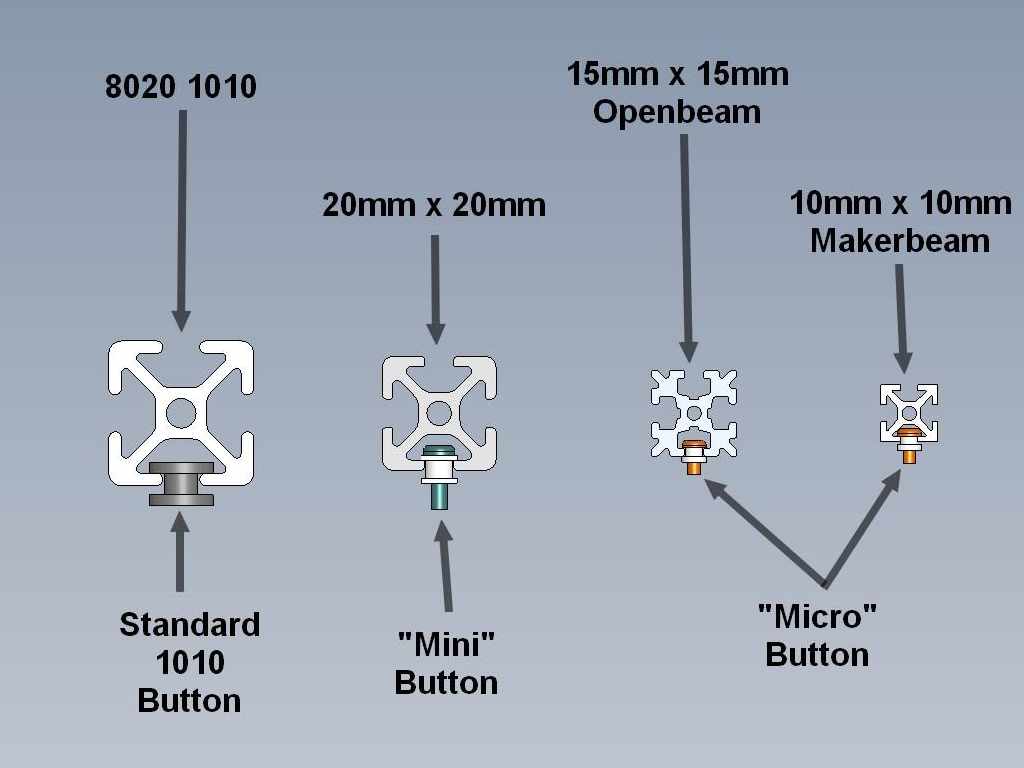
<p>There are 4 sizes of commercially available rail guides:</p>

<table>
  <thead>
    <tr>
      <th>Guide Size</th>
      <th>Rail</th>
    </tr>
  </thead>
  <tbody>
    <tr>
      <td>Micro</td>
      <td><a href="https://www.makerbeam.com/">MakerBeam</a> (10mm) <em>or</em> <a href="https://www.makerbeam.com/openbeam/">OpenBeam</a> (15mm)</td>
    </tr>
    <tr>
      <td>Mini</td>
      <td><a href="https://8020.net/20-2020.html">2020</a> (20mm)</td>
    </tr>
    <tr>
      <td>Standard/1010</td>
      <td><a href="https://8020.net/1010-s.html">1010</a> (1”), Blacksky rails</td>
    </tr>
    <tr>
      <td>1515</td>
      <td><a href="https://8020.net/1515-s.html">1515</a> (1.5”)</td>
    </tr>
  </tbody>
</table>

<figure class="picture lightbox">
  <a class="picture__anchor picture r3x4" href="/assets/images/terryg-rocket-rails.jpg">
    <div class="placeholder"></div>
    <img loading="lazy" class="picture__content" src="/assets/images/terryg-rocket-rails.jpg" alt="Common rail sizes for rocketry" />
  </a>
  <figcaption class="picture__caption">Common rail sizes for rocketry <cite><a href="https://www.rocketryforum.com/threads/micro-and-mini-rail-buttons.148246/#post-1818567">from terryg over at The Rocketry Forum</a></cite></figcaption>
</figure>

<p>The smaller two sizes–mini and micro–are available from <a href="https://rail-buttons.com">Rail-buttons.com</a>.
1010/starndard is the most common size so there are a variety of different styles and materials available from many different rocketry vendors.</p>

<h2 id="varieties">Varieties</h2>

<p>There are <em>lots</em> of options for 1010/standard size rail guides:</p>

<article class="wide-table-wrapper"><table>
  <thead>
    <tr>
      <th>Product</th>
      <th>Supplier</th>
      <th>Attachment</th>
      <th>Material</th>
      <th>Cost/pair</th>
      <th>Notes</th>
    </tr>
  </thead>
  <tbody>
    <tr>
      <td><a href="https://scpconcepts.com/airfoil-rail-guides/">Airfoil Rail Guide</a></td>
      <td><a href="https://scpconcepts.com/rocketry/">SC Precision</a></td>
      <td>Flat head screw</td>
      <td>Machined Delrin</td>
      <td>$7.00</td>
      <td>Teardrop shaped to reduce drag</td>
    </tr>
    <tr>
      <td><a href="https://aeropack.net/ldRailGuides.asp">Low-drag Rail Guide</a></td>
      <td><a href="https://aeropack.net">Aero Pack</a></td>
      <td>Flat head screw</td>
      <td>Machined Delrin</td>
      <td>$2.50</td>
      <td>Includes weld nuts</td>
    </tr>
    <tr>
      <td><a href="https://rail-buttons.com/1010delrin.html">New Style 1010</a></td>
      <td><a href="https://rail-buttons.com">Rail-buttons.com</a></td>
      <td>Flat head screw</td>
      <td>Molded Delrin</td>
      <td>$1.00</td>
      <td>10/pack, introductory price</td>
    </tr>
    <tr>
      <td><a href="https://rail-buttons.com/1010delrin.html">One-piece 1010</a></td>
      <td><a href="https://rail-buttons.com">Rail-buttons.com</a></td>
      <td>Pan head screw</td>
      <td>Molded Delrin</td>
      <td>$1.70/$1.45/$1.35</td>
      <td>2/10/30 packs</td>
    </tr>
    <tr>
      <td><a href="https://rail-buttons.com/1010delrin.html">3-piece 1010</a></td>
      <td><a href="https://rail-buttons.com">Rail-buttons.com</a></td>
      <td>Pan head screw</td>
      <td>Delrin</td>
      <td>76¢</td>
      <td>10/pack</td>
    </tr>
    <tr>
      <td><a href="http://rail-buttons.com/3p1010.html">3-piece 1010</a></td>
      <td><a href="https://rail-buttons.com">Rail-buttons.com</a></td>
      <td>Pan head screw</td>
      <td>Nylon</td>
      <td>50¢/48¢/46¢</td>
      <td>10/30/50 packs</td>
    </tr>
    <tr>
      <td><a href="https://publicmissiles.com/product/hardware">Linear Rail Lug</a></td>
      <td><a href="https://publicmissiles.com">PML</a></td>
      <td>Surface/Flat head screw</td>
      <td>Cast urethane</td>
      <td>$5.95</td>
      <td>Can be screwed and/or epoxied on ≥ 38mm airframes</td>
    </tr>
    <tr>
      <td><a href="https://wildmanrocketry.com/collections/rail-guides/products/conformal-rail-guides-2pk">Conformal Rail Guides</a></td>
      <td><a href="https://wildmanrocketry.com">Wildman Rocketry</a></td>
      <td>Surface/Flat head screw</td>
      <td>3D printed plastic</td>
      <td>$2.50</td>
      <td>Can be screwed and/or epoxied; diameter not specified</td>
    </tr>
    <tr>
      <td><a href="https://giantleaprocketry.com/products/components_launch_systems.aspx#Acme_Conformal_Launch_Guides">ACME Conformal® Rail Guide</a></td>
      <td><a href="https://giantleaprocketry.com/products/components_launch_systems.aspx">Giant Leap Rocketry</a></td>
      <td>Surface</td>
      <td>Extruded aluminum</td>
      <td>$3.99</td>
      <td>38mm to 7.5” diameter-specific; includes 3M adhesive strip</td>
    </tr>
    <tr>
      <td><a href="https://www.rosenfieldaerospace.com/Rail_Guides/cat2900835_2539336.aspx">Conformal Rail Guide</a></td>
      <td><a href="https://www.rosenfieldaerospace.com">Rosenfield Aerospace</a></td>
      <td>Surface</td>
      <td>3D printed plastic</td>
      <td>$2.99</td>
      <td>29mm to 5.54” LOC airframes; diameter specific</td>
    </tr>
    <tr>
      <td><a href="https://www.apogeerockets.com/Building-Supplies/Launch-Lugs-Rail-Buttons/Rail-Buttons-Guides/Universal-Rail-Guides">Universal Rail Guide</a></td>
      <td><a href="https://www.apogeerockets.com">Apogee Components</a></td>
      <td>Surface</td>
      <td>Cast urethane</td>
      <td>$3.28</td>
      <td>Any airframe size</td>
    </tr>
    <tr>
      <td><a href="https://www.apogeerockets.com/Launch-Accessories/Fly-Away-Rail-Guides">Fly-Away Rail Guide</a></td>
      <td><a href="https://www.apogeerockets.com">Apogee Components</a></td>
      <td>N/A</td>
      <td>Plywood</td>
      <td>$5.48-$13.60</td>
      <td>Leaves rocket on rail exit; 13mm to 54mm sizes</td>
    </tr>
    <tr>
      <td><a href="https://www.additiveaerospace.com/products/fly-away-rail-guides">Fly Away Rail Guide</a></td>
      <td><a href="https://www.additiveaerospace.com/">Additive Aerospace</a></td>
      <td>N/A</td>
      <td>Plastic, aluminum</td>
      <td>$30.00-$100.00</td>
      <td>Leaves rocket on rail exit; 38mm to 98mm sizes</td>
    </tr>
  </tbody>
</table>
<cite class="internal-reference"><small><a href="https://rocketlabdelta.com/lists/rail-guides">See list on separate page</a></small></cite>
</article>

<h2 id="selection">Selection</h2>

<p>You can spend between 46¢ and $100 to add a rail guide to your rocket.
Given the field, which one would you choose?</p>

<p>My favorites are:</p>

<ol>
  <li><a href="https://scpconcepts.com/airfoil-rail-guides/">SC Precision Airfoil Rail Guide</a> (when I’m feeling fancy–it’s $5 more per pair than my second choice). According to <a href="https://www.apogeerockets.com/downloads/PDFs/launch-lug-drag.pdf">analysis presented by Tim Van Milligan at NARCON 2017</a> (and <a href="https://www.apogeerockets.com/Building_Supplies/Launch_Lugs_Rail_Buttons/Rail_Buttons/Standard_Airfoiled_Rail_Buttons">referenced on the Apogee Components product page</a>), an airfoil rail guide with a rounded top edge has a coefficient of drag of .24 which is vastly better than the .57 of a conventional button-style rail guide. The drag coefficient is a <em>multiplier</em> in the <a href="https://www.grc.nasa.gov/www/k-12/airplane/drageq.html">drag equation</a> so lower is a lot better–especially at higher speeds (there’s a velocity squared in there).</li>
  <li><a href="https://aeropack.net/ldRailGuides.asp">Low-drag airframe mount rail guide from Aero Pack</a> are nicely machined Delrin that are mounted using a countersunk machine screw into a provided <a href="https://www.mcmaster.com/weld-nuts/steel-round-base-weld-nuts-9/">weld nut</a>. These are the nicest button-style guides I’ve found.</li>
</ol>

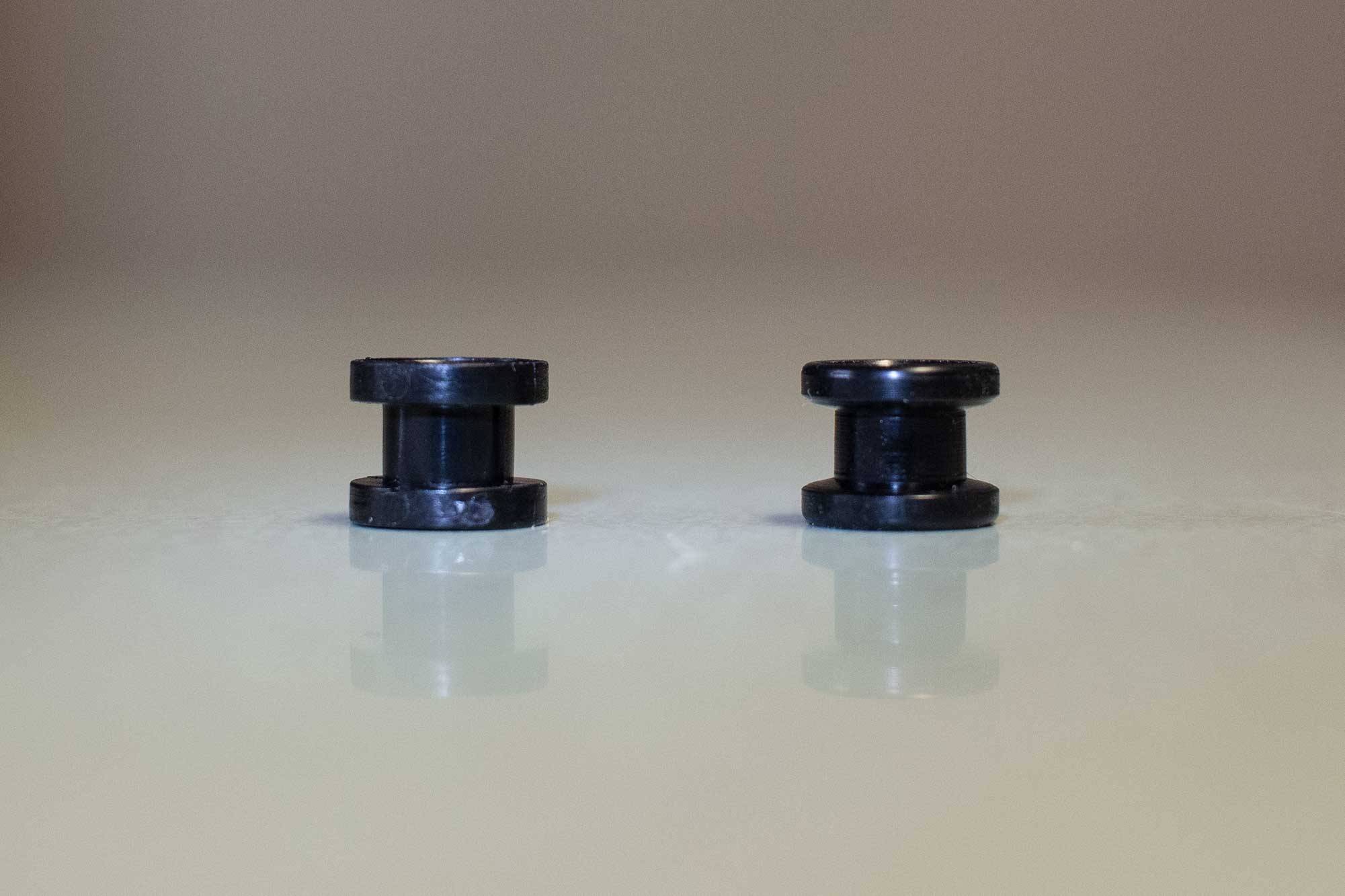
<p>The <a href="https://rail-buttons.com/1010delrin.html">new-style molded Delrin rail buttons from Rail-Buttons.com</a> are <em>almost</em> as nice as the ones from Aero Pack but the surface finish isn’t as smooth and they don’t come with <a href="https://rocketlabdelta.com/notes/rail-guides/#anchoring">an anchor</a> of any kind–just a machine screw.
They’re cheaper than the Aero Pack guides and perfectly decent quality so they are a good choice for most people.</p>

<figure class="picture lightbox">
  <a class="picture__anchor picture r2x3" href="/assets/photos/rail-guide-surface-comparison.jpg">
    <div class="placeholder"></div>
    <img loading="lazy" class="picture__content" src="/assets/photos/rail-guide-surface-comparison.jpg" alt="Molded rail guide on the left, machiened rail guide on the right" />
  </a>
  <figcaption class="picture__caption">The surface of the Rail-buttons.com molded rail guide (left) isn&rsquo;t <em>quite</em> as consistent as the Aero Pack machined rail guide (right)</figcaption>
</figure>

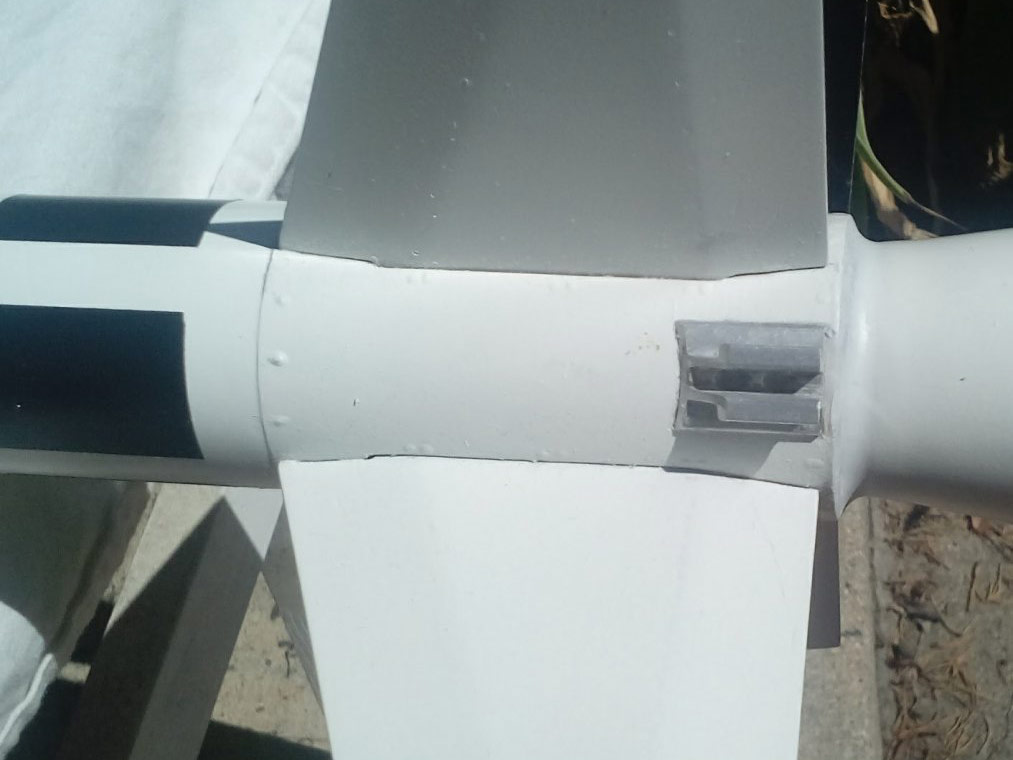
<p>I’ve also had good luck using <a href="https://giantleaprocketry.com/products/components_launch_systems.aspx#Acme_Conformal_Launch_Guides">ACME Conformal® Rail Guides</a> on minimum-diameter rockets.</p>

<figure class="picture lightbox">
  <a class="picture__anchor picture r3x4" href="/assets/photos/acme-conformal-rail-guide.jpg">
    <div class="placeholder"></div>
    <img loading="lazy" class="picture__content" src="/assets/photos/acme-conformal-rail-guide.jpg" alt="Silver aluminum rail guide bonded to a green filament-wound fiberglass airframe" />
  </a>
  <figcaption class="picture__caption">Detail view of the ACME Conformal® Rail Guide (54mm offset) on the <a href="/fleet/optimistic/">Optimistic</a></figcaption>
</figure>

<p>On the <a href="https://www.rocketryforum.com/">Rocketry Forum</a>, <a href="https://www.rocketryforum.com/members/mugs914.11309/">Mike Mulligan</a> suggests <a href="https://www.rocketryforum.com/threads/buttons-or-conformal-rail-guides.159723/#post-2005202">cutting an ACME Conformal® Rail Guide in half</a> and using the two halves for one rocket.
That sounds like a good idea to me!</p>

<figure class="picture lightbox">
  <a class="picture__anchor picture r3x4" href="/assets/photos/mugs914-rail-guide.jpg">
    <div class="placeholder"></div>
    <img loading="lazy" class="picture__content" src="/assets/photos/mugs914-rail-guide.jpg" alt="Half an ACME Conformal® Rail Guide, pointy side up, near the aft end of a white rocket." />
  </a>
  <figcaption class="picture__caption"><cite>Good tip from <a href="https://www.rocketryforum.com/threads/buttons-or-conformal-rail-guides.159723/#post-2005202">Mike Mulligan (Mugs914) over at The Rocketry Forum</a></cite></figcaption>
</figure>

<h2 id="placement">Placement</h2>

<p>While most rockets only have one launch lug, rockets need <em>at least</em> two rail guides<sup id="fnref:4"><a href="#fn:4" class="footnote" rel="footnote" role="doc-noteref">4</a></sup>.
The <a href="http://archive.rocketreviews.com/reviews/all/bs_railsystem.shtml">original recommendation from Blacksky</a> was to mount one at the base of the rocket and the other 1–2 calibers below the center of gravity.
This method is <a href="https://www.rocketryforum.com/threads/rail-guide-placement.63945/#post-686591">casually endorsed by John Coker</a>, and it’s what I’ve always done (because I followed the instructions that came with my first rail guides).
There are other opinions too:</p>

<blockquote>
  <p>You should place the two buttons so that they are on either side of the Center-of-Gravity (CG) of the rocket.
Further apart is better if you have room.<br />
<cite>Tim Van Milligan <a href="https://www.apogeerockets.com/education/downloads/Newsletter489.pdf">Peak of Flight #489</a>, p. 2</cite></p>
</blockquote>

<blockquote>
  <p>Install one rail button 1” from the aft end of the rocket, and another [1.5 caliber] from the front of the airframe.<br />
<cite>Mike Westerfield, <a href="https://www.oreilly.com/library/view/make-high-power-rockets/9781680454796/">Make: High Power Rockets</a> Figure 3-52, p. 57</cite></p>
</blockquote>

<p>All told, it doesn’t seem to matter a whole lot where they are placed as long as you have two of them anchored to the airframe in a straight line.</p>

<h2 id="anchoring">Anchoring</h2>

<p>It’s important to firmly attach rail guides to the airframe of your rocket but you can do it in a lot of different ways:</p>

<ul>
  <li>Screw it into the airframe (backed with epoxy clay) see <a href="https://www.apogeerockets.com/education/downloads/Newsletter489.pdf">Peak of Flight #489</a></li>
  <li>Screw it into an internal structure–a centering ring, for example–like the <a href="https://aeropack.net/ldRailGuides.asp">blukhead mount (RG10B) rail guides from Aero Pack</a></li>
  <li>Use a Weld nut like the <a href="https://aeropack.net/ldRailGuides.asp">low drag rail guides (RG10A) from Aero Pack</a>; other styles of weld nut can be <a href="https://www.mcmaster.com/weld-nuts/">sourced from McMaster-Carr</a></li>
  <li>Use a DIY weld nut e.g. a piece of aluminum tapped for a machine screw, <a href="https://www.oreilly.com/library/view/make-high-power-rockets/9781680454796/">Make: High Power Rockets</a> p. 56</li>
  <li>Mount a T-nut on a small piece of plywood e.g. <a href="https://www.youtube.com/watch?v=Xtr3758PvzA">Certify Level 1 by John Coker</a></li>
  <li>Mount a T-nut on a 3D printed plastic slug curved to fit the inside diameter of the airframe like the <a href="https://www.labratrocketry.com/product-page/conformal-rail-button-nuts">Conformal Rail Button Nuts from Lab Rat Rocketry</a></li>
  <li>Glue a regular machine screw nut to the inside of the airframe with or without a plastic nut holder like the <a href="https://www.smtdesigns.com/store/6-32-nut-holder-kit-for-1010-rail-buttons">Nut Holder Kit for 1010 Rail Buttons</a> from <a href="https://www.smtdesigns.com/">SMT Designs</a></li>
  <li>Glue it to the surface of the airframe using a bonding epoxy or, in the case of the <a href="https://giantleaprocketry.com/products/components_launch_systems.aspx#Acme_Conformal_Launch_Guides">ACME Conformal® Rail Guide</a>, a strip of 3M permanent adhesive</li>
</ul>

<p>There isn’t a clear winner here.
The best anchoring method will depend on the size, weight, and configuration of the rocket.
I like to have the ability to remove and replace the rail guide if needed so I favor options that add metal threads to the airframe like a plywood-mounted internal T-nut, a weld nut, or a plastic nut holder.</p>

<p class="divider">* * *</p>

<p>Launch rails are better than launch rods for most rockets.
There are a lot of options to choose from when selecting and mounting rail guides but there aren’t many <em>bad</em> ones.
Pick any pair you like, or go with one of <a href="https://rocketlabdelta.com/notes/rail-guides/#selection">my recommendations</a>, <a href="https://rocketlabdelta.com/notes/rail-guides/#anchoring">fasten them securely to your rocket</a>, and fly higher &amp; safer.</p>

<div class="footnotes" role="doc-endnotes">
  <ol>
    <li id="fn:1">
      <p>I have heard of people using sailboat masts as improvised launch rails in the 90s. They sunk screws most of the way into the airframe and then slid the screw head down the channel of the mast. <a href="#fnref:1" class="reversefootnote" role="doc-backlink">&#8617;</a></p>
    </li>
    <li id="fn:2">
      <p>Because they were the de facto standard, you still see “Blacksky compatible” in marketing copy for rails and rail guides on some rocketry vendor websites 20 years later. <a href="#fnref:2" class="reversefootnote" role="doc-backlink">&#8617;</a></p>
    </li>
    <li id="fn:3">
      <p>My dad and I were early adopters of launch rails and used them with rockets down to 38mm in diameter. My dad also used them extensively with his <a href="https://rocketcontest.org/">TARC teams</a>. <a href="#fnref:3" class="reversefootnote" role="doc-backlink">&#8617;</a></p>
    </li>
    <li id="fn:4">
      <p>Two rail guides are sufficient for typical rockets. I have seen 3 rail guides used on <em>very</em> long, slender rockets and, occasionally, on two-stage rockets but those are exceptional cases. You might be able to get away with one, long rail guide–like the <a href="https://publicmissiles.com/product/hardware">PML linear rail lug</a>–on a small, squat rocket but I don’t think it’s worth it. Fly-away rail guides like the ones from <a href="https://www.apogeerockets.com/Launch-Accessories/Fly-Away-Rail-Guides">Apogee Components</a> or <a href="https://www.additiveaerospace.com/products/fly-away-rail-guides">Additive Aerospace</a> are a better choice if you are trying to minimize parasitic drag. <a href="#fnref:4" class="reversefootnote" role="doc-backlink">&#8617;</a></p>
    </li>
  </ol>
</div>]]></content><author><name>Dan Brubaker Horst</name></author><category term="notes" /><summary type="html"><![CDATA[History and application of launch rails and rail guides in hobby rocketry]]></summary></entry><entry><title type="html">Making Time</title><link href="https://rocketlabdelta.com/updates/making-time/" rel="alternate" type="text/html" title="Making Time" /><published>2020-06-09T11:55:00+00:00</published><updated>2020-06-09T11:55:00+00:00</updated><id>https://rocketlabdelta.com/updates/making-time</id><content type="html" xml:base="https://rocketlabdelta.com/updates/making-time/"><![CDATA[<p>I struggle with <a href="https://www.frugalwoods.com/2016/03/16/the-tyranny-of-time-optimism/">time optimism</a><sup id="fnref:1"><a href="#fn:1" class="footnote" rel="footnote" role="doc-noteref">1</a></sup> (I think it will take me <em>way</em> less time to do something than it actually does).
This makes it easy to become demoralized because I consistently fail to meet my own (unreasonable) expectations for my productivity.</p>

<p>To help keep me accountable, I’m using <a href="https://www.beeminder.com">Beeminder</a> to track the <a href="https://www.beeminder.com/danhorst/rockets">time I spend on rockets</a> (work on the website counts too).
I set a goal of doing at least 4 hours a week.
This encourages me to carve out small chucks of time from my day to spend time doing the things I love instead of assuming I’ll get to it eventually once my battle with entropy–otherwise known as being an adult homeowner–is won.</p>

<p>I’ll reassess in a few weeks but it’s been working well for me so far.</p>

<p><em>UPDATE 2020-08-18</em> I have stopped using Beeminder for tracking my recreation time.
I ended up stressing out about it thus diminishing its utility.
For the foreseeable future, I will be juggling lots of things around the house that are more important than fulfilling a quota of hours for recreation.</p>

<hr />

<p>I know there’s a lot of unrest in the world right now.
I am privileged to be able to set aside time for self-care.
Even in the face of widespread fear and grave injustice, it is still important to take care of yourself–just don’t stick your head in the sand.</p>

<div class="footnotes" role="doc-endnotes">
  <ol>
    <li id="fn:1">
      <p>This means I routinely fall victim to the <a href="https://en.wikipedia.org/wiki/Planning_fallacy">planning fallacy</a>. <a href="#fnref:1" class="reversefootnote" role="doc-backlink">&#8617;</a></p>
    </li>
  </ol>
</div>]]></content><author><name>Dan Brubaker Horst</name></author><category term="updates" /><summary type="html"><![CDATA[It's OK to set aside time for recreation]]></summary></entry><entry><title type="html">Altimiters in 2020</title><link href="https://rocketlabdelta.com/notes/altimiters-in-2020/" rel="alternate" type="text/html" title="Altimiters in 2020" /><published>2020-02-14T21:42:00+00:00</published><updated>2020-02-14T21:42:00+00:00</updated><id>https://rocketlabdelta.com/notes/altimiters-in-2020</id><content type="html" xml:base="https://rocketlabdelta.com/notes/altimiters-in-2020/"><![CDATA[<p>As I awaken from my <a href="https://rocketlabdelta.com/essays/backstory/">fifteen-year rocketry slumber</a> and <a href="https://rocketlabdelta.com/essays/gps-telemetry-in-2020/">take a look around</a> the market for altimeters is very different<sup id="fnref:1"><a href="#fn:1" class="footnote" rel="footnote" role="doc-noteref">1</a></sup>.
All the vendors I was familiar with–BlackSky, AED, Transolve, Olsen, G-Wiz, Adept–are gone.
Cheap, powerful microcontrollers, and even whole computers, can be easily fit into rockets thanks to <a href="https://www.arduino.cc/">Arduino</a>, <a href="https://www.raspberrypi.org/">Raspberry Pi</a>, <a href="https://beagleboard.org/">Beagleboard</a>, and others.
Why not grab an <a href="https://www.sparkfun.com/pages/accel_gyro_guide">accelerometer breakout board from Sparkfun</a> (<a href="https://www.sparkfun.com/products/12803">like this one</a>, rated to 200g!) wire it up, and gather all the data your heart desires?</p>

<p>I might take this approach for electronic payloads in the future but I <em>do not</em> want to trust the safe recovery of my rocket to my embedded programming skills.
It would be one thing if all I wanted to know is how high the flight was<sup id="fnref:2"><a href="#fn:2" class="footnote" rel="footnote" role="doc-noteref">2</a></sup>, but, as it is, I expect a lot more from my avionics.</p>

<h2 id="criteria">Criteria</h2>

<p>Here’s what I want:</p>

<ul>
  <li><strong>Small</strong>: the altimeters of yore required a 38mm mounting tube, we can do better than that.</li>
  <li><strong>Multi-sensor</strong>: lots of altimeters only have barometric sensors. This works great while measuring the <em>descent</em> of a rocket, but it is not particularly well-suited for measuring and recording the <em>ascent</em> of a rocket<sup id="fnref:3"><a href="#fn:3" class="footnote" rel="footnote" role="doc-noteref">3</a></sup>. During powered flight, I want a sensitive accelerometer gathering data at a high polling rate.</li>
  <li><strong>Recording</strong>: I don’t just want to what the maximum altitude was, I want to be able to inspect the entire flight profile, export the data, and be able to analyze it later.</li>
  <li><strong>Pyro-channels</strong>: I want to be able to <em>at least</em> fire drogue and main recovery charges for dual deployment flights. Safe<sup id="fnref:4"><a href="#fn:4" class="footnote" rel="footnote" role="doc-noteref">4</a></sup> staging and air-start controls are a bonus.</li>
  <li><strong>Li-Po friendly</strong>: Lithium polymer batteries are light, can deliver high current, and are rechargeable. It is better battery technology than alkaline 9 volts or the NiCads of old.</li>
  <li><strong>Phone-first</strong>: I don’t want to have to lug a laptop around with me to configure or retrieve data from my altimeter. I want to use the computer I have in my pocket–my (Android) phone.</li>
</ul>

<h2 id="options">Options</h2>

<p>The players (in alphabetical order):</p>

<ul>
  <li><strong>Adrel Electronics</strong>: the <a href="https://northcoastrocketry.com/collections/accessories/products/adrel-atl-bmp-altimeter">ATL-BMP</a> (~$70) is a tiny competition altimeter. It is just a 1g data logger; the maximum altitude and flight profile are calculated after the fact using Windows desktop software.</li>
  <li><a href="https://altusmetrum.org/"><strong>Altus Metrum</strong></a>: the <a href="https://altusmetrum.org/EasyMega/">EasyMega</a> (~<a href="https://www.apogeerockets.com/Electronics-Payloads/Dual-Deployment/EasyMega">$350</a>) is a fairly-compact (fits in a 38mm coupler), multi-sensor recording altimeter designed to work with LiPo batteries. It is also available with a 2m HAM-band radio downlink as the <a href="https://altusmetrum.org/TeleMega/">TeleMega</a> (~<a href="https://www.apogeerockets.com/Electronics-Payloads/Altimeters/TeleMega">$460</a>). The <a href="https://altusmetrum.org/EasyMini/">EasyMini</a> (~<a href="https://www.apogeerockets.com/Electronics-Payloads/Dual-Deployment/EasyMini">$93</a>) is a dual-deploy recording altimeter that is <em>much</em> smaller (fits in a 24mm coupler) and cheaper but is barometric-only. All three of these altimeters, even the smaller one, have built-in USB ports for downloading flight data to a computer.</li>
  <li><a href="http://entacore.com/electronics/home"><strong>ENTACore Electronics</strong></a>: <a href="http://entacore.com/electronics/aimusb">AIM USB</a> (~$115) fairly-compact, LiPo-friendly, recording altimeter with built-in USB connectivity–barometric only, <a href="http://entacore.com/electronics/aimxtra">AIM XTRA</a> <em>also</em> has GPS telemetry and is thus expensive (~$420).</li>
  <li><a href="http://eggtimerrocketry.com/"><strong>Eggtimer Rocketry</strong></a>: the <a href="http://eggtimerrocketry.com/eggtimer-proton/">Proton</a> (~$70) has all the features I want but the package size is too large and you have to solder it together yourself–that’s why it’s so inexpensive. My soldering and electronics debugging skills are not up to that level.</li>
  <li><a href="https://www.featherweightaltimeters.com/"><strong>Featherweight Altimiters</strong></a>: the <a href="https://www.featherweightaltimeters.com/raven-altimeter.html">Raven 4</a> (~$160) has a spec sheet that reads like a dream and you can get a <a href="https://www.featherweightaltimeters.com/store/p7/Featherweight_Avionics_Bay.html">24mm telemetry bay</a> for it! Still expects a USB/PC interface though.</li>
  <li><a href="https://flightsketch.com/"><strong>FlightSketch</strong></a>: only offers the <a href="https://flightsketch.com/store/catalog/flightsketch-mini_1/">Mini</a> (~$40) right now and that isn’t what I’m looking for. However, the <a href="https://flightsketch.com/about/">design philosophy</a> is spot-on so I have high hopes for the rest of their product line. The <a href="https://flightsketch.com/store/catalog/flightsketch-sport_227/">Sport</a> looks just about perfect and the <a href="https://flightsketch.com/store/catalog/flightsketch-sst_228/">SST</a> (GPS tracker) also looks promising.</li>
  <li><a href="https://www.jollylogic.com/"><strong>Jolly Logic</strong></a>: the <a href="https://www.jollylogic.com/products/altimeterthree/">Altimeter 3</a> (~$100) is a recording altimeter that works with your phone but there are no pyro channels. The <a href="https://www.jollylogic.com/products/chuterelease/">Chute Release</a> is super cool though. It makes other modes of dual-deployment possible in such a way that I may need to rethink my criteria for avionics.</li>
  <li><a href="http://marsasystems.com/"><strong>Marsa Systems</strong></a>: the Marsa33LHD (~$200) is a <em>very</em> sophisticated flight computer–you can even get it ruggedized for $20 more–but it’s really big (54mm diameter mounting tube) and is built for a USB/PC interface. <a href="http://marsasystems.com/index.php/gadgets/marsanet-gadgets">MarsaNet</a> is a wireless (!) expansion module system (~$70/RX–up to 2, ~$50/TX) that adds more pyro channels–this is kind of crazy but a cool idea.</li>
  <li><a href="https://www.missileworks.com/"><strong>Missile Works</strong></a>: the <a href="https://www.missileworks.com/rrc3/">RRC3</a> (~<a href="https://www.missileworks.com/store/#!/RRC3-Sport-Altimeter/p/25239688/category=5760485">$70</a>-<a href="https://www.missileworks.com/store/#!/RRC3-Xtreme-Altimeter/p/25239703/category=5760485">$80</a>) and <a href="https://www.missileworks.com/rrc2/">RRC2+</a> (~<a href="https://www.missileworks.com/store/#!/RRC2-Altimeter/p/28645468/category=6735554">$45</a>) are barometric-only with an “old-school” vibe. The RRC3 is a recording altimeter and it can also be used with their <a href="https://www.missileworks.com/rtx/">telemetry packages</a> to transmit live data to a ground station.</li>
  <li><a href="http://www.perfectflite.com/"><strong>PerfectFlite</strong></a>: the <a href="http://www.perfectflite.com/SLCF.html">StratoLoggerCF</a> (~$70) is a small, barometric-only, dual-deploy, recording altimeter. It requires a <a href="http://www.perfectflite.com/dt4u.html">separate USB adapter</a> (~$30) to download the data to a PC.</li>
</ul>

<h2 id="tldr"><abbr title="Too Long; Didn't Read">TLDR</abbr></h2>

<p>Great.
No products on the market–at least that I could find–meet all of my criteria.
Given the field, my recommendations are:</p>

<ol>
  <li><a href="https://www.featherweightaltimeters.com/raven-altimeter.html">Featherweight Altimeters Raven 4</a> ~$160</li>
  <li><a href="https://altusmetrum.org/EasyMini/">Altus Metrum EasyMini</a> (<a href="https://www.apogeerockets.com/Electronics-Payloads/Dual-Deployment/EasyMini">available from Apogee Components</a>) ~$93</li>
  <li><a href="http://www.perfectflite.com/SLCF.html">PerfectFlite StratoLoggerCF</a> with <a href="http://www.perfectflite.com/dt4u.html">USB adapter</a> ~$100 total</li>
</ol>

<p><strong>HONORABLE MENTION</strong>: <a href="http://marsasystems.com/">Marasa Systems Marsa33LHD</a> (~$200) is super cool–it’s got that <em>serious</em> flight computer look and the specs to back it up.
Because of its size, it is only suitable for <abbr title="High-Power Rocketry">HPR</abbr>.
Marasa Systems feels like the spiritual successor to AED.</p>

<p>I’m holding out hope that the <a href="https://flightsketch.com/store/catalog/flightsketch-sport_227/">FlightSketch Sport</a> will be released soon because it is the only product I’ve found that ticks all the boxes.</p>

<div class="footnotes" role="doc-endnotes">
  <ol>
    <li id="fn:1">
      <p>I know because I am in the market for an altimeter. Technically, I have one already: an AED R-DAS mini that has been sitting in a cardboard box for the better part of a decade. Have the capacitors degraded? Does it need to be calibrated? I don’t know. Also, AED went out of business last year and the only copy I have of the control software is sitting on a 3.5” floppy. It probably still works fine but I’ll have to use a USB-serial adapter and hope Windows Compatibility mode can sort everything out (assuming I can <em>find</em> a floppy drive somewhere). <a href="#fnref:1" class="reversefootnote" role="doc-backlink">&#8617;</a></p>
    </li>
    <li id="fn:2">
      <p>If you join NAR they send you a copy of the “NAR Member Guidebook” that has all kinds of helpful information. “How High Does It Go? Electronic Altimeters” by Bernard Cawley has a detailed breakdown of 8 model-rocket-sized maximum altitude altimeters. They are all competition certified. <a href="#fnref:2" class="reversefootnote" role="doc-backlink">&#8617;</a></p>
    </li>
    <li id="fn:3">
      <p>Reasons for this include low polling rates, low resolution, and worse yet if the rocket breaks the sound barrier there will be a pressure wave that makes the readings unstable during the mach transition. (This used to cause all kinds of problems with old altimeters–like parachutes deploying when the rocket is traveling at maximum speed because of a sharp decrease in pressure registered as an apogee event. Then “mach” timers were included to prevent deployment charges from firing for a set number of seconds. Now, I hear this is all avoided with better software but I’m still wary.) <a href="#fnref:3" class="reversefootnote" role="doc-backlink">&#8617;</a></p>
    </li>
    <li id="fn:4">
      <p>By “safe” I mean: “Don’t start the second stage if <em>unless</em> it is flying straight up or at a safe angle of attack.” This is why you need sophisticated embedded programming at the heart of your avionics. <a href="#fnref:4" class="reversefootnote" role="doc-backlink">&#8617;</a></p>
    </li>
  </ol>
</div>]]></content><author><name>Dan Brubaker Horst</name></author><category term="notes" /><summary type="html"><![CDATA[What is the best way to tell how high your rocket went and control its recovery?]]></summary></entry><entry><title type="html">GPS Telemetry in 2020</title><link href="https://rocketlabdelta.com/notes/gps-telemetry-in-2020/" rel="alternate" type="text/html" title="GPS Telemetry in 2020" /><published>2020-02-13T13:26:00+00:00</published><updated>2020-02-13T13:26:00+00:00</updated><id>https://rocketlabdelta.com/notes/gps-telemetry-in-2020</id><content type="html" xml:base="https://rocketlabdelta.com/notes/gps-telemetry-in-2020/"><![CDATA[<p>It’s <em>really</em> easy to lose a high-power rocket.
Sending a rocket thousands of feet up into the atmosphere in only a few seconds means and you can:</p>

<ul>
  <li>Loose visual track of the rocket as it ascends into the sky due to cloud cover or it simply moving too fast</li>
  <li>Loose visual track of the rocket as it descends and not know where it landed</li>
  <li>Have the rocket severely weathercock (turn into the wind) and arc towards the horizon</li>
  <li>Deploy a parachute that provides a safe descent rate at apogee, or another high altitude, either on purpose, or due to a dual-deploy malfunction, and have it be carried off by prevailing winds</li>
  <li>Have everything work perfectly but still need to walk several miles to recover it</li>
</ul>

<p>There are ways to mitigate each of these occurrences but having a tracking device of some kind helps lend peace of mind.
No one wants to lose a rocket.
They are expensive: components, all the time you spent getting things just right, avionics, reloadable motor hardware, etc.
And, the whole point of flying a rocket is to get it back and do it again.</p>

<p>In the late 90s and early aughts I used two methods of tracking:</p>

<ul>
  <li>A 440MHz beacon made by Adept (now out of business; the beacon also required a HAM radio license, scanner, and directional gain antenna)</li>
  <li>GPS telemetry</li>
</ul>

<p>At that time, I only flew GPS telemetry occasionally in the <a href="https://rocketlabdelta.com/fleet/g-rag-3/">G-RAG 3 rocket</a> because it was a <a href="https://rocketlabdelta.com/fleet/g-rag-3/#payload">large and complicated payload</a>.</p>

<h2 id="things-have-changed">Things Have Changed</h2>

<p>Some of the biggest advancements in hobby rocketry in the past 20 years have been in electronics.
They have gotten dramatically smaller, more sophisticated, and cheaper (at least in some cases).
This is due, in part, to a proliferation of:</p>

<ul>
  <li>Tiny, cheap GPS modules driven my demand to put GPS receivers in smartphones and other consumer electronic devices</li>
  <li>New license-free radio standards like <a href="https://zigbeealliance.org/">Zigbee</a> and <a href="https://lora-alliance.org/">LoRa</a></li>
</ul>

<p>Because electronics vendors for hobby rocketry are themselves hobbyists or small businesses there is a lot of turn-over.
Virtually all the vendors I bought electronics from 20 years ago are out of business.
Some are even zombies–I’ve come across several websites that <em>appear</em> to have products for sale but links are broken or pages haven’t been updated in years.
You can still use electronics after the vendor has closed its doors but the control software (if there is any) will gradually become incompatible with modern computers.</p>

<p>Between 2001 and now, independent of hobby rocketry, smartphones have gone from not existing to being our de facto computing devices.
I would prefer not to have to lug a laptop out to the launch site and have it set up next to an effectively immobile<sup id="fnref:1"><a href="#fn:1" class="footnote" rel="footnote" role="doc-noteref">1</a></sup> ground station when I have a smartphone in my pocket.
Despite this, most rocketry electronics either assume you will use them with a PC or they implement functionally that could be provided by a smartphone app in a proprietary way.</p>

<h2 id="commercially-available-gps-trackers-for-rocketry">Commercially Available GPS Trackers for Rocketry</h2>

<p><a href="http://jcrocket.com">John Coker</a> has <a href="http://jcrocket.com/gps-tracking.shtml">a good write-up of GPS trackers c2015</a> it goes into a lot of technical detail.
Start there for a good overview and an excellent discussion of antenna gain mechanics.
However, it only covers a few products from 3 vendors–there are a lot more options out there.
Here is a survey of what I could find from scouring the Internet:</p>

<ul>
  <li><a href="https://www.multitronix.com/">Multitronix TelemetryPro</a> has two variants of sophisticated trackers &amp; receivers with a 100-mile range ~$2000(!)</li>
  <li><a href="https://www.apogeerockets.com/Electronics-Payloads/Rocket-Locators/Simple-GPS-Tracker">Apogee Simple GPS tracker</a> is a one-piece custom-built ground station and small tracker ~$430 (a smartphone app would be a preferable alternative to custom, hand-held ground station)</li>
  <li><a href="https://www.featherweightaltimeters.com/featherweight-gps-tracker.html">Featherweight Altimiters has LoRa GPS Tracker</a> that can be purchased with a small Bluetooth ground station (iOS app; Android planned but not available) <a href="https://www.featherweightaltimeters.com/store/p14/GPS_Tracker.html.html">~$350 (sale price)</a></li>
  <li><a href="https://shop.bigredbee.com/collections/vhf-uhf-transmitters">BigRedBee has several VHF/UHF GPS APRS transmitter offerings</a> that operate on 70cm and 2m HAM radio bands ~$260-$360 for  <em>only</em> a transmitter, ground station equipment not included.
    <ul>
      <li>You <em>should</em> be able to use something like the <a href="http://www.mobilinkd.com/">Mobilinkd TNC3</a> ~$120 to bridge a HAM radio and your phone via Bluetooth as described in <a href="https://wcares.org/special-interests-3/aprs/aprs-bluetooth-adapter/">this article</a>.</li>
    </ul>
  </li>
  <li><a href="https://altusmetrum.org/">Altus Metrum</a> has several GPS-enabled products that use a 70cm HAM band and pair with their Bluetooth ground station, <a href="https://altusmetrum.org/TeleBT/">TeleBT</a> ~$170, which needs to be connected to a directional antenna like a <a href="http://www.arrowantennas.com/arrowii/440-3ii.html">70cm Arrow Antenna</a> ~$60:
    <ul>
      <li><a href="https://altusmetrum.org/TeleGPS/">TeleGPS</a>, tracker only ~$230 (~$460 total)</li>
      <li><a href="https://altusmetrum.org/TeleMetrum/">TeleMetrum</a>, dual-deploy recording altimeter with GPS telemetry ~$350 (~$580 total)</li>
      <li><a href="https://altusmetrum.org/TeleMega/">TeleMega</a>, dual-deploy recording altimeter with loads of options, onboard gyro, RC servo controller, and GPS telemetry ~$460 (~$690 total)</li>
    </ul>
  </li>
  <li><a href="http://eggtimerrocketry.com/home/eggfinder-gps-tracking-system/">Eggtimer Rocketry has several 900MHz &amp; 70cm GPS transmitters</a> and they keep costs low by only offering the electronic kits you have to solder yourself. <a href="http://eggtimerrocketry.com/purchase/">Their “starter sets” start at ~$90</a> for a pair of RX and TX modules.</li>
  <li><a href="http://entacore.com/electronics/home">ENTACore Electronics</a> <a href="http://entacore.com/electronics/aimxtra">AIM XTRA GPS flight computer</a> is a full-on flight computer (barometric sensor, 3-axis accelerometer, hi-G linear accelerometer) with pyro channels and USB connectivity that transmits live telemetry on the 432-434 MHz band ~$420 for flight computer and ground station.</li>
  <li><a href="https://www.missileworks.com/">Missle Works</a> has several <a href="https://www.missileworks.com/rtx/">RTx/GPS Systems</a> (~<a href="https://www.missileworks.com/store/#!/RTx-GPS-Telematics-Standard-System/p/67718379/category=25228107">$260</a>-<a href="https://www.missileworks.com/store/#!/RTx-GPS-Telematics-Navigator-System/p/67781466/category=25228107">$290</a>) that use standard Zigbee modules to transmit data to a ground station with <a href="https://www.missileworks.com/store/#!/RTx-RRC3-Bluetooth-Master-Module/p/67977422/category=5895759">Bluetooth</a> (~$15), <a href="https://www.missileworks.com/store/#!/USB-IO-Dongle/p/25232707/category=5895759">USB/PC</a> (~$25), or <a href="https://www.missileworks.com/store/#!/LCD-Terminal/p/25232679/category=5895759">onboard LCD</a> (~$40) display options. The RTx system can also stream data from their <a href="https://www.missileworks.com/rrc3/">RRC3 altimeter</a> (~<a href="https://www.missileworks.com/store/#!/RRC3-Sport-Altimeter/p/25239688/category=5760485">$70</a>-<a href="https://www.missileworks.com/store/#!/RRC3-Xtreme-Altimeter/p/25239703/category=5760485">$80</a>). I think their <a href="https://www.missileworks.com/t3/">T3</a> (~<a href="https://www.missileworks.com/store/#!/T3-GPS-Tracking-System/p/90226446/category=25228124">$155-$190</a>) tracker is a more interesting product as it is cheaper, smaller, lighter, and specifically meant for using a smartphone as part of your ground station (they only recommend Android apps but I bet there are iOS apps out there that could work).</li>
  <li><a href="https://flightsketch.com/">FlightSketch</a> is working on a <a href="https://flightsketch.com/store/catalog/flightsketch-sst_228/">“Super Simple Tracker”</a>, a 900MHz LoRa/GPS unit. No information yet on pricing or availability yet but their other products are very reasonable <em>and</em> they have an app-first approach for delivering features via your phone.</li>
</ul>

<p>Another alternative is to get a cheap/used Android phone and use the <a href="https://play.google.com/store/apps/details?id=com.insanerocketry.insanerockets&amp;hl=en_US">Insane Rockets</a> app to beam back telemetry information via a cellular data connection.
(Phones are only suitable payloads for large rockets.)
This <em>also</em> assumes there will be cell service at your launch site–most fields big enough for rocketry are in rural areas which can have poor network coverage.</p>

<p>There are trackers in the consumer electronics market that could be repurposed for rocketry like <a href="https://www.seeedstudio.com/LoRaWAN-GPS-Tracker-with-9-axis-accelerometer-LGT92-p-2922.html">this LoRa/GPS from Seed Studio</a>, a <a href="https://trackimo.com/">GSM/GPS units from Trackimo</a>, or even an <a href="https://tryfi.com/">LTE-M/WiFi/GPS dog collar from fi</a>.
These have design goals that line up with their intended uses so they usually make one or more of the following trade-offs that make them less than ideal for rocketry:</p>

<ul>
  <li>Larger packages that weigh more</li>
  <li>Non-removable batteries</li>
  <li>Not be ruggedized for the forces of flight and (worst case) impact</li>
  <li>Lose satellite fix under high speeds</li>
  <li>Have low GPS polling rates to save battery life</li>
</ul>

<p>These aren’t deal breakers, but I haven’t found any consumer products that are dramatically cheaper for a whole <em>system</em>: transmitter, receiver, phone interface <em>and</em> makes good design trade-offs.
A possible exception are GPS trackers meant for falconry (yes really) like those from <a href="https://marshallradio.com/">Marshall Radio</a> but a full GPS system can easily add up to north of $1500.</p>

<aside>
For the DIY inclined it shouldn&rsquo;t be <em>too</em> hard to graft a <a href="https://www.u-blox.com/en">ublox</a> <a href="https://www.u-blox.com/en/positioning-chips-and-modules">GPS module</a> to an off-the-shelf Zigbee wireless module&mdash;the <a href="https://www.missileworks.com/t3/">Missile Works T3</a> is essentially just that.
<a href="https://www.sparkfun.com">Sparkfun</a> has a <a href="https://www.sparkfun.com/gps">GPS overview</a> and <a href="https://www.sparkfun.com/pages/GPS_Guide">product guide</a> that might help.
</aside>

<h2 id="tldr"><abbr title="Too Long; Didn't Read">TLDR</abbr></h2>

<p>For my needs (small, light, works with a phone as a ground station), the best options are:</p>

<ol>
  <li><a href="https://www.missileworks.com/t3/">Missile Works T3</a> (RPSMA version with 4.7” rigid 1/2 wave dipole antenna), ~$170</li>
  <li><a href="https://www.featherweightaltimeters.com/store/p14/GPS_Tracker.html.html">GPS tracker by Featherweight Altimeters</a>, ~$350 (the only problem is I don’t have an iPhone)</li>
  <li><a href="https://flightsketch.com/store/catalog/flightsketch-sst_228/">FlightSketch SST</a>–only an announced product, not yet available</li>
</ol>

<hr />

<h2 id="state-of-android-apps">State of Android Apps</h2>

<p>I spent a <em>lot</em> of time trying to find Android apps that would work with the Missile Works T3<sup id="fnref:2"><a href="#fn:2" class="footnote" rel="footnote" role="doc-noteref">2</a></sup>.
Ideally, the app would do three things:</p>

<ol>
  <li>Track the GPS location of the transmitter (received via Bluetooth)</li>
  <li>Track your current position based on the built-in phone GPS</li>
  <li>Plot the heading and report the distance between your position and the beacon’s position</li>
</ol>

<p>Of the three apps recommended by MissileWorks, only <a href="http://rocketlocator.com/">RocketLocator</a> is still available in the <a href="https://play.google.com/store/apps/details?id=com.frankdev.rocketlocator">Google Play Store</a> and it appears to meet the functional criteria.
It is built around the <a href="https://sourceforge.net/p/bluegps4droid/home/Home/">BluetoothGPS4Droid (SourceForge)</a> (<a href="https://github.com/somehume/bluegps4droid">Github mirror</a>) library for interacting with Bluetooth GPS modules.
That library hasn’t been updated since 2013 and uses a <a href="https://code.google.com/archive/p/backport-android-bluetooth/">backport of a deprecated Bluetooth API</a> to work with modern versions of Android.
This isn’t great but if it works, it works.
The app itself was updated in 2019 with compatibility fixes–so that’s a good sign–but it looks dated and is a bit rough around the edges.</p>

<p>The next best option is to split the tasks up across multiple apps.</p>

<h3 id="transmitter-tracking">Transmitter tracking</h3>

<p>Android does not have native support for Bluetooth GPS devices–you need to rely on a third-party app.
I found several apps that claim to support this but <em>by far</em> the most common recommendation is <a href="https://play.google.com/store/apps/details?id=googoo.android.btgps">Bluetooth GPS</a> (<a href="https://support.garmin.com/en-US/?faq=1BEq2yXIPj5SdcTfdXrdd6">Garmin even recommends it</a> for use with their <a href="https://buy.garmin.com/en-US/US/p/645104">Glow 2 Bluetooth GPS</a>).
Unfortunately, the app hasn’t been updated since 2015 and appears to be completely unsupported–it’s starting to become incompatible with recent versions of Android.
That doesn’t look good.</p>

<p><strong>Bottom line</strong>: I can’t confirm if the Missile Works T3 is compatible with <a href="https://play.google.com/store/apps/details?id=googoo.android.btgps">Bluetooth GPS</a> on Android 10 and if it <em>doesn’t</em> work there aren’t any other good apps out there to fill this need<sup id="fnref:3"><a href="#fn:3" class="footnote" rel="footnote" role="doc-noteref">3</a></sup>.</p>

<p>As an alternative, it may be possible to connect a Window laptop<sup id="fnref:4"><a href="#fn:4" class="footnote" rel="footnote" role="doc-noteref">4</a></sup> to the ground station via <a href="https://www.gpssensordrivers.com/">GPSDirect</a><sup id="fnref:5"><a href="#fn:5" class="footnote" rel="footnote" role="doc-noteref">5</a></sup>.</p>

<h3 id="phone-tracking">Phone tracking</h3>

<p><a href="https://play.google.com/store/apps/details?id=com.eclipsim.gpsstatus2&amp;hl=en_US">GPS Status</a> is an excellent tracking app.</p>

<ul>
  <li>It is a modern app (supports Dark Mode, etc) and recently updated (2019-09).</li>
  <li>Its pro mode removes adds for $1.99. I paid for this immediately.</li>
  <li>In “Radar” mode it supports tracking one or more locations at GPS coordinates you specify.</li>
  <li>It supports “picture in picture” mode so it could be run “over top” of a transmitter tracking app (or anything else).</li>
</ul>

<div class="footnotes" role="doc-endnotes">
  <ol>
    <li id="fn:1">
      <p>I mean, you could drive it around in a car if you wanted. Assuming you have at least a driver and someone to monitor the ground station. Also, you would need to be able to drive where you needed to go, which is frequently not the case when chasing rockets through farm fields, etc. <a href="#fnref:1" class="reversefootnote" role="doc-backlink">&#8617;</a></p>
    </li>
    <li id="fn:2">
      <p>I’m trying to get the app situation sorted before I buy it or recommend that others do the same. <a href="#fnref:2" class="reversefootnote" role="doc-backlink">&#8617;</a></p>
    </li>
    <li id="fn:3">
      <p>There are <em>lots</em> of apps that make the GPS on your phone available over Bluetooth for <em>other</em> devices. You can still get tablets without built-in GPS but apparently, the market for apps that <em>consume</em> GPS-over-Bluetooth isn’t big enough to attract a lot of app developers. <a href="#fnref:3" class="reversefootnote" role="doc-backlink">&#8617;</a></p>
    </li>
    <li id="fn:4">
      <p>The <a href="http://gpd.hk/gpdmicropc">GPD MicroPC</a> comes to mind as a good option for a mobile ground station. <a href="#fnref:4" class="reversefootnote" role="doc-backlink">&#8617;</a></p>
    </li>
    <li id="fn:5">
      <p>Most Bluetooth GPS devices don’t work out-of-the-box with Windows either. It seems pretty common for Bluetooth-enabled GPS modules to simply treat the Bluetooth connection as if it were a serial data connection. The data feed needs to be parsed and translated into something that the location services part of the operating system can understand what is going on. <a href="#fnref:5" class="reversefootnote" role="doc-backlink">&#8617;</a></p>
    </li>
  </ol>
</div>]]></content><author><name>Dan Brubaker Horst</name></author><category term="notes" /><summary type="html"><![CDATA[What is the best way to make sure you will find your rocket?]]></summary></entry><entry><title type="html">Reexamining Rocket Fin Aerodynamics</title><link href="https://rocketlabdelta.com/status/tiny-wings-kickoff/" rel="alternate" type="text/html" title="Reexamining Rocket Fin Aerodynamics" /><published>2020-01-26T15:28:00+00:00</published><updated>2020-01-26T15:28:00+00:00</updated><id>https://rocketlabdelta.com/status/tiny-wings-kickoff</id><content type="html" xml:base="https://rocketlabdelta.com/status/tiny-wings-kickoff/"><![CDATA[<p>The <a href="https://rocketlabdelta.com/projects/tiny-wings">Tiny Wings project</a> will determine the fin design for my second<sup id="fnref:1"><a href="#fn:1" class="footnote" rel="footnote" role="doc-noteref">1</a></sup> <abbr title="High Power Rocketry">HPR</abbr> Level 1 certification launch vehicle.
I may post occasional updates in the blog, but the bulk of the work will happen on <a href="https://www.notion.so/rocketlabdelta/Tiny-Wings-735759a802c7463d80e9c062c92b8e26">the project page in Notion</a>.
Whe1 the project is complete, it’ll be published on <a href="https://rocketlabdelta.com/projects/tiny-wings">its project page here</a>.</p>

<div class="footnotes" role="doc-endnotes">
  <ol>
    <li id="fn:1">
      <p>Come to find out, certifications expire if you don’t maintain active membership in a rocketry organization. <a href="#fnref:1" class="reversefootnote" role="doc-backlink">&#8617;</a></p>
    </li>
  </ol>
</div>]]></content><author><name>Dan Brubaker Horst</name></author><category term="status" /><summary type="html"><![CDATA[Project Kickoff: Tiny Wings]]></summary></entry><entry><title type="html">Why I Like Rocketry</title><link href="https://rocketlabdelta.com/essays/why-i-like-rocketry/" rel="alternate" type="text/html" title="Why I Like Rocketry" /><published>2020-01-25T13:07:00+00:00</published><updated>2020-01-25T13:07:00+00:00</updated><id>https://rocketlabdelta.com/essays/why-i-like-rocketry</id><content type="html" xml:base="https://rocketlabdelta.com/essays/why-i-like-rocketry/"><![CDATA[<p>I like rocketry for two primary reasons:</p>

<ol>
  <li>It is a way of concretely connecting with things I think are cool like space travel, powered flight, and stuff that goes super fast.</li>
  <li>It presents a wide variety of challenges that I have fun solving in different ways.</li>
</ol>

<figure class="picture lightbox">
  <a class="picture__anchor picture r4x3" href="/assets/photos/1998-Cape-Canaveral-with-grandpa.jpg">
    <div class="placeholder"></div>
    <img loading="lazy" class="picture__content" src="/assets/photos/1998-Cape-Canaveral-with-grandpa.jpg" alt="Family trip to Cape Canaveral" />
  </a>
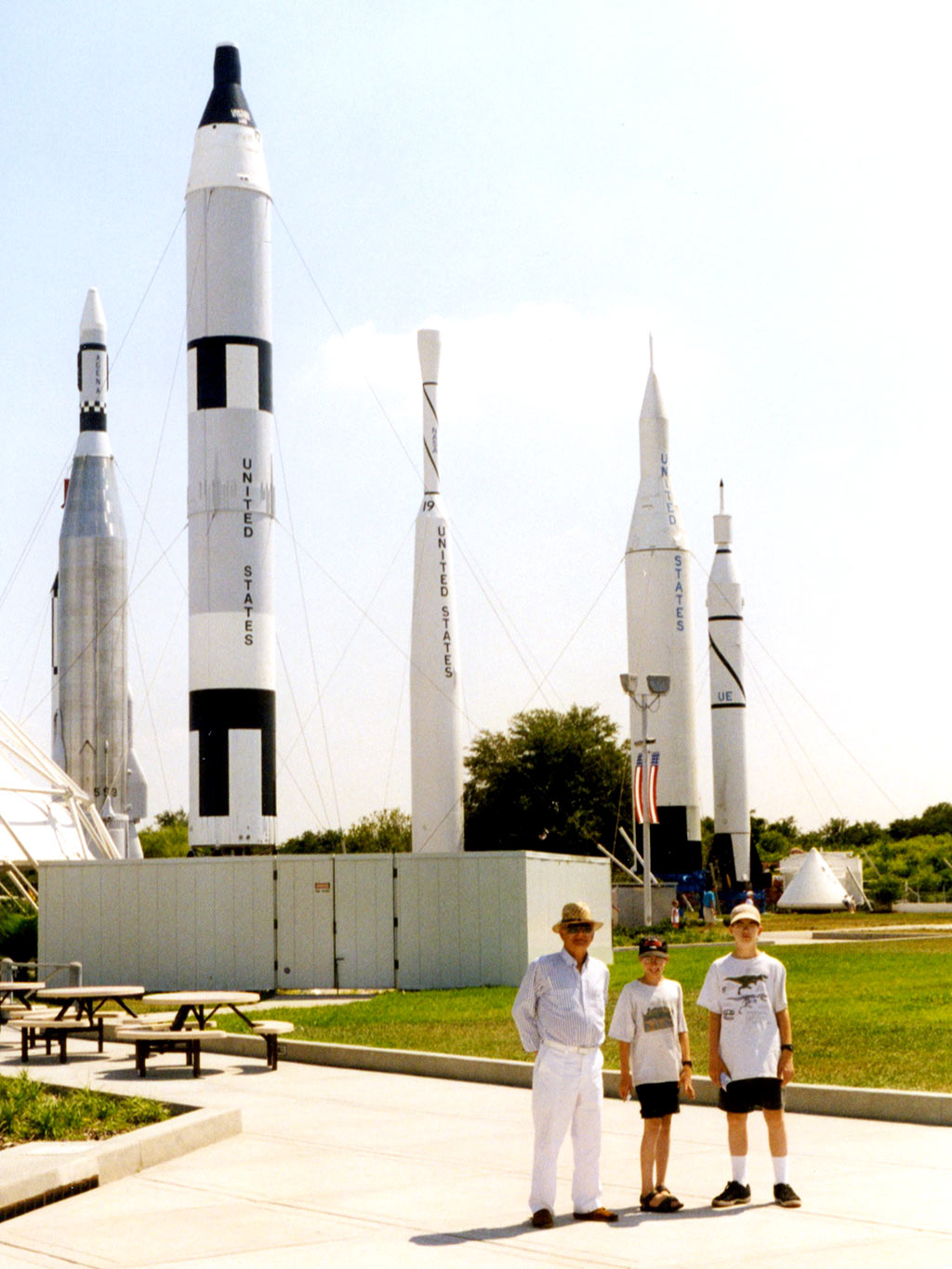
  <figcaption class="picture__caption">My grandpa, brother (center), and I outside a rocket garden in Cape Canaveral, FL in 1998. Rockets featured: Atlas Agina, Titan II, Thor-Able, Juno II, Juno I</figcaption>
</figure>

<p>Rocketry has a lot of engineering challenges that are accessible to people who aren’t trained as engineers.
For example, even the most technical sections of the <a href="https://www.amazon.com/Handbook-Model-Rocketry-7th-Official/dp/0471472425">Handbook of Model Rocketry</a> employ high-school-level physics.
(I had a blast in high school physics!)
These challenges come in two flavors: building &amp; flying.</p>

<h2 id="building">Building</h2>

<p>Building a rocket can be as easy or as hard as you want it to be.
For beginners, Estes has <a href="https://estesrockets.com/product-category/rockets/beginner/">ready-to-fly rocket kits</a> and if you want something rated for high-power grab <a href="https://giantleaprocketry.com/products/components_fins.aspx#Acme_Fin_Cans">an ACME fin can from Giant Leap Rocketry</a> and you’re almost done.
When you’re ready for more <a href="http://www.fusionrocket.biz/">SBR</a>, for example, has well-designed <abbr title="High Power Rocketry">HPR</abbr> kits with very detailed instructions–you just have to follow them and put it together.</p>

<p>I don’t make very many rocket kits because I enjoy the process of making trade-offs when I design rockets from scratch.
There are lots of things to consider:</p>

<ol>
  <li><strong>Motor selection retention, and ignition</strong>: “right-sizing” for the rocket, the launch field, the waiver, and how far you want to walk</li>
  <li><strong>Aerodynamics</strong>: rocket length &amp; diameter, fin size &amp; shape, airfoil design, transitions, etc.</li>
  <li><strong>Material selection &amp; construction</strong>: airframes, nose cones, structural components, adhesives, etc.</li>
  <li><strong>Recovery system</strong>: harness, fasteners, parachute(s), heat shielding and/or baffling (nylon parachutes melt under the direct heat of an ejection charge), flight electronics, parachute releases, recovery bags, etc.</li>
  <li><strong>Finishing</strong>: filling, painting, cosmetic details, decals, etc.</li>
</ol>

<p>The most common thing to fail in an <abbr title="High Power Rocketry">HPR</abbr> flight is the recovery system.
(This isn’t that surprising because it is the most complicated part of a rocket flight.)
Common failures include:</p>

<ul>
  <li>The nose cone comes off too easily and the ejection charge “blows past” the parachute leaving it still in the rocket body.</li>
  <li>The parachute doesn’t fully deploy or gets tangled.</li>
  <li>The electronics fail for some reason and the rocket hits the ground at ballistic speed.</li>
</ul>

<p>Go to a rocket launch and watch for what goes wrong.
Think about what you could to do mitigate the risk of that happening to you.</p>

<p>I have also seen rockets fall to pieces under thrust.
It’s better to over-build and have it weigh a little more than for a rocket to break apart and be hazardous to spectators.</p>

<h2 id="flying">Flying</h2>

<p>You need a big field and an <abbr title="Federal Aviation Administration">FAA</abbr> waiver to fly high-power rockets.
Because of this, virtually all rockets from mid-power on up are flown at launches organized by a regional rocket club.
Do some research and find where clubs are in your area.
The field size requirements mean that launches are, as a rule, in a rural area so you’ll probably have to drive for a while to get there.
Both <a href="https://www.nar.org/"><abbr title="National Association of Rocketry">NAR</abbr></a> and <a href="http://www.tripoli.org/">Tripoli</a> have annual launches, <abbr title="National Association of Rocketry Annual Meet">NARAM</abbr> and <abbr title="Large and Dangerous Rocket Ships">LDRS</abbr> respectively.
They are defiantly worth the trip if you can make it.</p>

<p>I like prepping my rockets in the field.
This means:</p>

<ul>
  <li>Assembling re-loadable motors like <a href="http://www.aerotech-rocketry.com/">AeroTech</a> <abbr title="Reloadable Motor System">RMS</abbr> or <a href="http://www.pro38.com/">Cesaroni</a> ProX</li>
  <li>Packing the recovery system</li>
  <li>Loading ejection charges</li>
  <li>Testing flight electronics</li>
  <li>Checking for the right amount of friction between rocket components that separate during flight</li>
</ul>

<p>Make a checklist!
There are lots of things to remember!</p>

<p>At launches, there are lots of people to meet and talk to where you already have something in common (besides the weather).
It’s fun to walk around and see what other people are doing and their take on the hobby.
Maybe I’ll see you there someday!</p>]]></content><author><name>Dan Brubaker Horst</name></author><category term="essays" /><summary type="html"><![CDATA[An outline of what's involved in hobby rocketry]]></summary></entry><entry><title type="html">Backstory</title><link href="https://rocketlabdelta.com/essays/backstory/" rel="alternate" type="text/html" title="Backstory" /><published>2020-01-25T00:39:46+00:00</published><updated>2020-01-25T00:39:46+00:00</updated><id>https://rocketlabdelta.com/essays/backstory</id><content type="html" xml:base="https://rocketlabdelta.com/essays/backstory/"><![CDATA[<p>My name is <a href="https://www.danhorst.com">Dan Brubaker Horst</a> and I am a <abbr title="Born-Again Rocketeer">BAR</abbr>.
I reconnected with rocketry in 2020 after leaving the hobby in the early 2000s.
My first rocket was an Estes Bull Pup I saw at Walmart as a seventh-grader in 1995.
I was introduced to High Power Rocketry the next year by Kurt Cripe, a friend’s dad.
My first <abbr title="High Power Rocketry">HPR</abbr> launch was in Three Oaks, MI in the fall of 1996.
My dad, Ken Horst, and I dove deep into rocketry after that.</p>

<figure class="picture lightbox">
  <a class="picture__anchor picture r1x1" href="/assets/photos/1996-early-model-rocket-launch.jpg">
    <div class="placeholder"></div>
    <img loading="lazy" class="picture__content" src="/assets/photos/1996-early-model-rocket-launch.jpg" alt="Early model rocket launch in 1996" />
  </a>
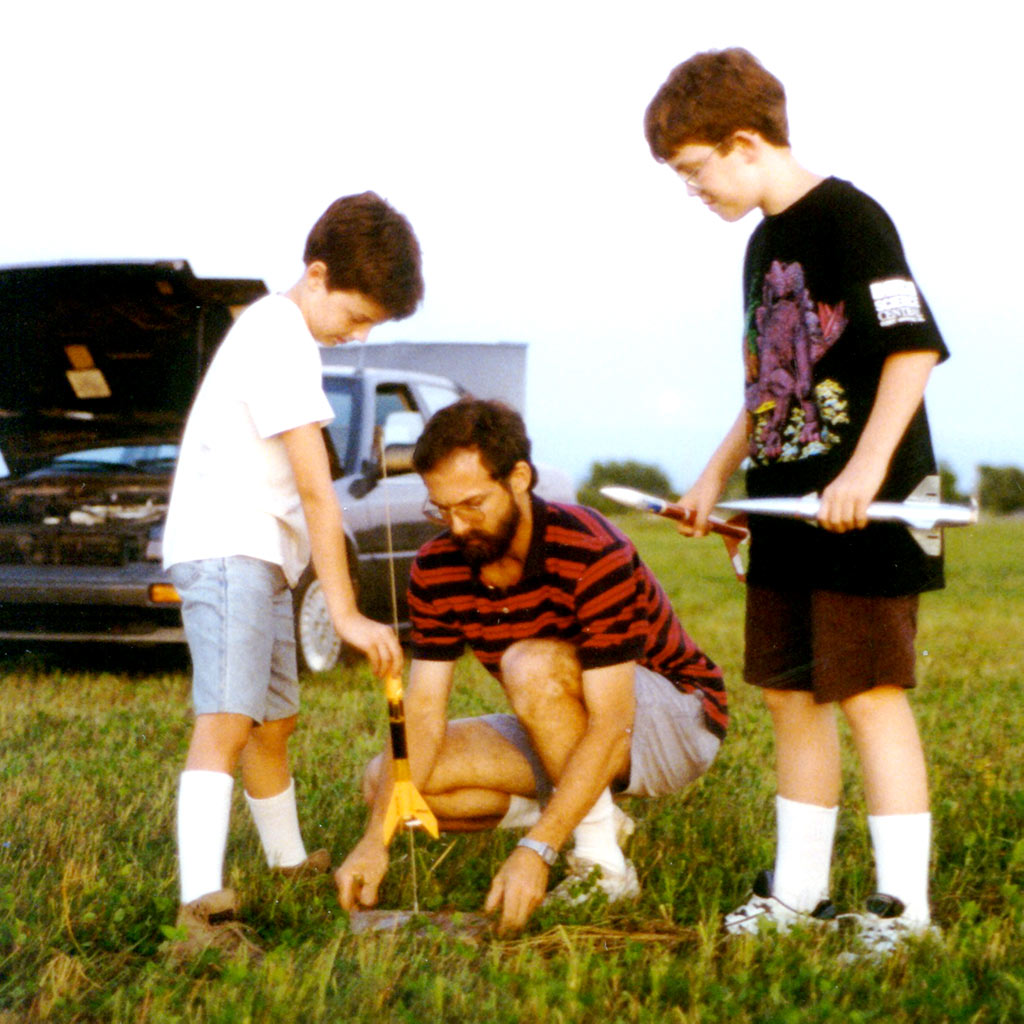
  <figcaption class="picture__caption">An early rocket launch with my dad &amp; brother (left). The hood of the car is up because we used the car battery to set off the motor igniters. Rockets featured: Estes Alpha III, Estes Nova (with Lego astronaut as payload), Estes Bull Pup</figcaption>
</figure>

<p>The basement workshop of my parent’s home was christened “The Rocket Lab” and it was outfitted with progressively larger power tools so that we could fabricate more sophisticated rockets.
Over the next 8 years, I spent countless hours in the shop learning and practicing how to build rockets that could withstand the forces of high-power flight and recovery.
I fabricated dozens upon dozens of components–fins, bulkheads, centering rings, pistons, “sleds” for electronics, etc.–from balsa, aircraft-grade plywood, and G-10 fiberglass sheeting accented with aluminum, cork, cherry wood, all-thread, t-nuts, polystyrene, and stainless steel fittings.
I used a lathe to turn many a nose cone from poplar and, occasionally, basswood.
I learned how to use different viscosities and formulations of cyanoacrylate (super glue) and epoxy to make bonds and reinforce surfaces.
I used fiberglass, Kevlar, and carbon fiber to strengthen airframes, laminate fins, and reinforce joints.
I got quite good at filling wood grain, smoothing surfaces, and using spray paint.</p>

<p>In the fall of 1997, I discovered the rocketry competition at the Elkhart County 4-H fair, one of the largest county fairs in the nation, and said to myself “I could do better than that” after looking at my competition.
For the next four years, every year I was eligible to compete, my rocket was selected for the state fair.
I still have two of my entries: a scratch-built 3” Ares (4×29mm), and a scratch-built 2-stage BT-60 WAC Corporal (3×18mm to 24mm).
Neither one of them has flown but they were designed and built so that they could.</p>

<figure class="picture lightbox">
  <a class="picture__anchor picture r1x1" href="/assets/photos/1998-4-H-WAC-Corporal.jpg">
    <div class="placeholder"></div>
    <img loading="lazy" class="picture__content" src="/assets/photos/1998-4-H-WAC-Corporal.jpg" alt="4-H WAC Corporal in 1998" />
  </a>
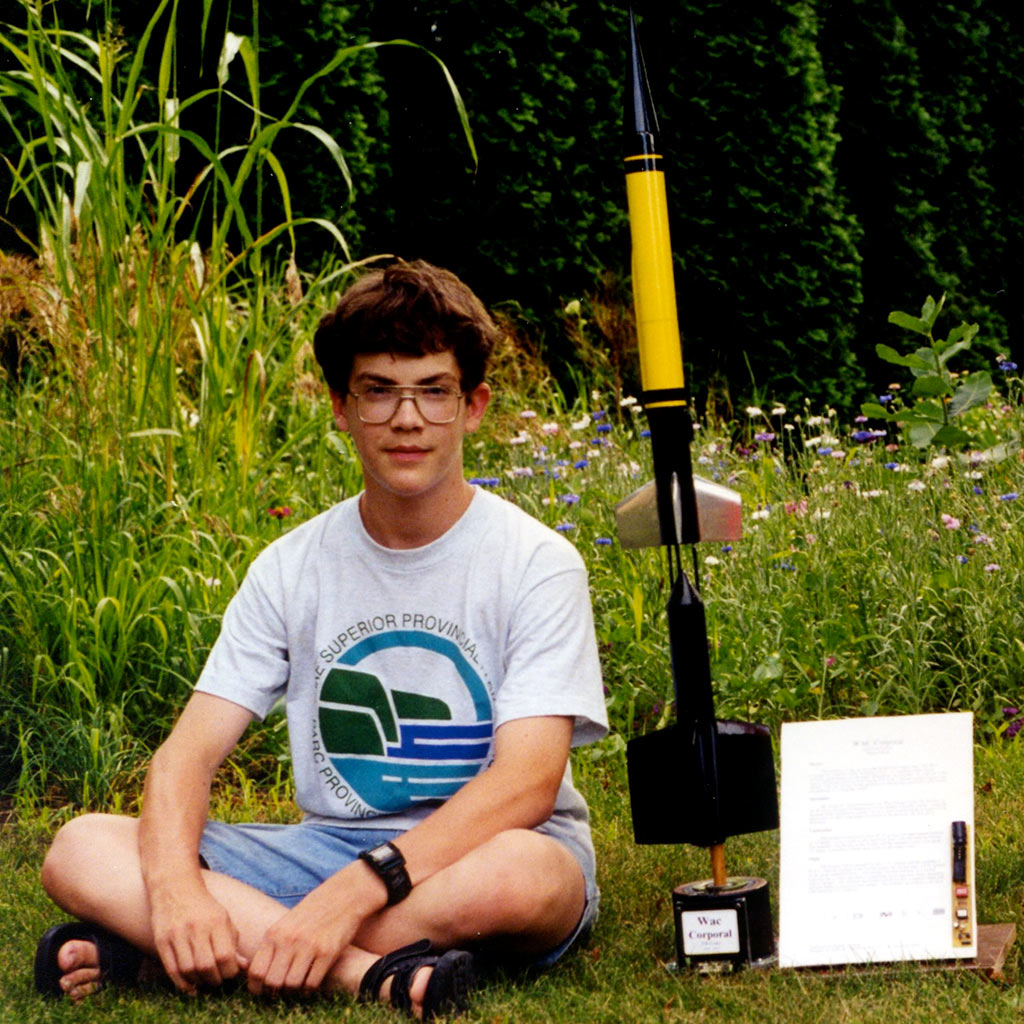
  <figcaption class="picture__caption">My 4-H WAC Corporal. I turned both nose cones and built the telescoping stage coupler with heavy-gauge music wire and aluminum tubing.</figcaption>
</figure>

<p>My dad and I started using avionics early on in our <abbr title="High Power Rocketry">HPR</abbr> models.
We tried many different altimeters but used the BlackSky AltAcc the most.
My personal favorite was the AED R-DAS which was the same form factor as the AltAcc but gathered more data and had a serial bus to attach additional sensors.
(Both Blacksky and AED are no longer in business.)
I scratch-built at least a half dozen dual-deployment rockets trying out different arrangements for recovery bays, power management, pyrotechnic charges, arming switches, and recovery harnesses.</p>

<p>By 2001, we were ready to do something more sophisticated with electronic payloads.
My dad started the Goshen Radios Aloft Group (G-RAG) where we enlisted several HAM radio enthusiasts to help develop a real-time GPS telemetry package that used packet radio over the 2-meter HAM radio band.
Our final project was featured in the January/February issue of Sport Rocketry in 2002.
The <a href="/fleet/g-rag-3/">3-inch launch vehicle I built for that project</a> flew different payload configurations for several years starting in 2001.
The rocket was retired after losing a fin to a hard landing in the Nevada desert at <abbr title="Large and Dangerous Rocket Ships">LDRS</abbr> 26 (2007).</p>

<figure class="picture lightbox">
  <a class="picture__anchor picture r2x3" href="/assets/photos/2001-G-RAG-3-payload.jpg">
    <div class="placeholder"></div>
    <img loading="lazy" class="picture__content" src="/assets/photos/2001-G-RAG-3-payload.jpg" alt="G-RAG 3 payload" />
  </a>
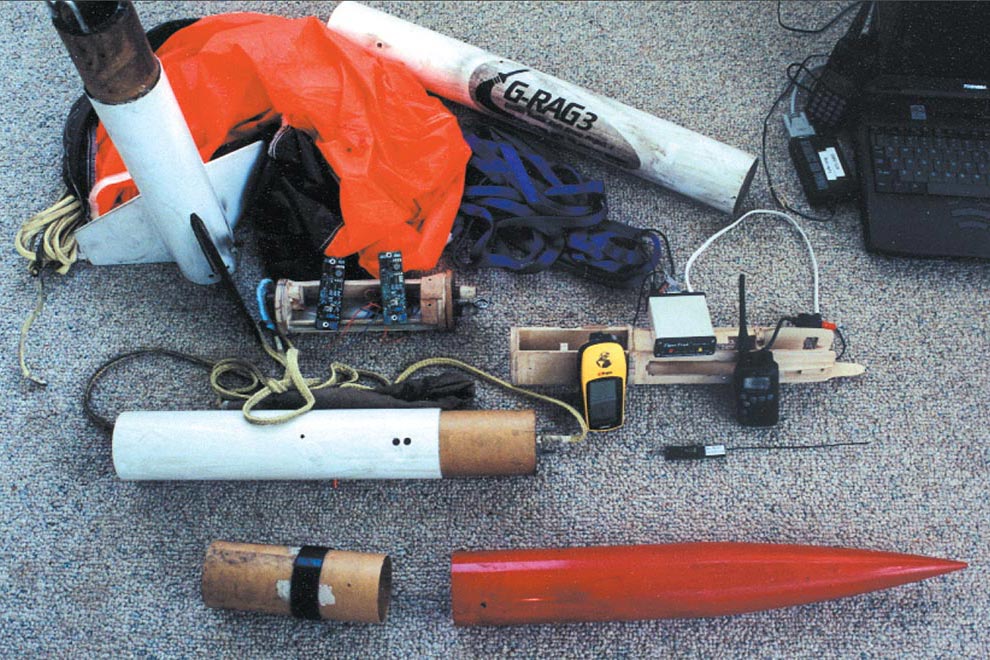
  <figcaption class="picture__caption">Avionics &amp; telemetry payload and ground station for the G-RAG 3 rocket. Electronics have gotten a <em>lot</em> smaller since then. See <a href="/essays/gps-telemetry-in-2020/">GPS Telemtry in 2020</a> to see what you can do almost 20 years later.</figcaption>
</figure>

<p>My dad was a physics teacher at Goshen High School and coached at least one team for <a href="https://rocketcontest.org/">The American Rocketry Challenge</a> from its inaugural year in 2002 until he retired in 2012.
Several of his teams made it to nationals.
I missed the age cutoff to participate as a team member (only by a year!) so I served as an assistant coach for a few teams instead.
I helped with web content, built a reference launch vehicle, and helped out where I could.
One of the Goshen High School teams was selected to participate in <a href="https://www.nasa.gov/stem/studentlaunch/home/">NASA Student Launch</a> after placing well and I played an assisting role in that project too.</p>

<p>My last rocketry endeavors before the long break were:</p>

<ul>
  <li><a href="/fleet/overseer/">Overseer</a>: A 4-inch diameter dual-altimeter, dual-deploy rocket I used to certify <abbr title="Tripoli Rocketry Association">TRA</abbr> Level 2 at <abbr title="Large and Dangerous Rocket Ships">LDRS</abbr> 21 in Wayside, TX (2002)</li>
  <li><a href="/fleet/optimistic/">Optimistic</a>: A 54mm minimum-diameter Dynacom filament-wound fiberglass rocket I flew to 8300 feet at <abbr title="Large and Dangerous Rocket Ships">LDRS</abbr> 23 in Geneseo, NY (2004)</li>
</ul>]]></content><author><name>Dan Brubaker Horst</name></author><category term="essays" /><summary type="html"><![CDATA[How I got into rocketry in the first place]]></summary></entry></feed>